
Secure Processing Enclaves for Crypto Asset Exchanges and Custodians
How cryptocurrency exchanges and custodians can implement hardware-enforced secure processing enclaves using data diodes to protect private keys while maintaining operational efficiency. Learn how the Expanse Data Diode and Expanse Network Stack enable air-gapped security architectures.
Secure Processing Enclaves for Crypto Asset Exchanges and Custodians
Cryptocurrency exchanges and custodians operate in one of the most security-critical environments in the financial sector. With billions of dollars in digital assets under management, these organizations face unique challenges that traditional financial institutions never encountered. The immutable nature of blockchain transactions means that security mistakes are permanent; there is no central authority to reverse fraudulent transfers or recover stolen assets.
Market growth and security gaps
The cryptocurrency exchange market has grown quickly, with over 250 exchanges operating worldwide and the sector expanding faster than many traditional capital markets. That growth has not always kept pace with security practice.
Historical Security Failures
Major exchanges like Mt. Gox, Coincheck, Bancor, and Bitfinex have all suffered catastrophic security breaches. These incidents highlight a fundamental problem: the same decentralized trust properties that make blockchain technology secure also make security mistakes unforgiving. When private keys are compromised, there is no way to undo the damage.
The Regulatory Challenge
Regulators are understandably cautious about security tokenization and cryptocurrency adoption, even when they understand the technology and appreciate its efficiency. The question "What if something goes wrong?" looms large when there is no mechanism to reverse a crypto heist or recover stolen assets.
Traditional Security Approaches and Their Limitations
Most cryptocurrency exchanges and custodians use one of two primary approaches for securing private keys:
Hot Wallets: Connected but Vulnerable
Hot wallets are online systems that keep private keys available for immediate transaction processing. They offer:
- High Availability: Keys are always accessible for trading operations
- Fast Transaction Processing: No delay in signing transactions
- Operational Efficiency: Straightforward integration with trading platforms
However, hot wallets present significant security risks:
- Network Exposure: Connected to the internet, making them vulnerable to remote attacks
- Software Vulnerabilities: Firewalls and security software can be misconfigured or exploited
- Attack Surface: Every network connection represents a potential entry point for attackers
Cold Storage: Secure but Isolated
Cold storage systems keep private keys completely offline in air-gapped networks. They provide:
- Maximum Security: No network connectivity means no remote attack vectors
- Physical Isolation: Complete separation from internet-connected systems
- Regulatory Compliance: Meets requirements for institutional custody
But cold storage has operational drawbacks:
- Slow Access: Retrieving keys from cold storage typically requires manual processes
- No Monitoring: Air-gapped networks cannot send alerts or status updates
- Operational Friction: Every transaction requires physical access and manual procedures
The Cold Storage Dilemma: While air-gapped cold storage provides maximum security, it creates operational challenges that can impact customer experience and business operations. Exchanges need security without sacrificing operational efficiency.
The Solution: Hardware-Enforced Secure Processing Enclaves
Domain Systems' Expanse Data Diode provides a third option that combines the security of air-gapped systems with the operational efficiency of connected networks. By using hardware-enforced unidirectional data flows, exchanges can create secure processing enclaves that protect private keys while maintaining necessary operational capabilities.
 Don't be a victim!
This approach has been adopted by leading cryptocurrency custodians. Coinbase, one of the world's largest digital asset exchanges, has implemented cross-domain solutions (CDS) technology for their custody operations. As they describe in their custody standards documentation:
"Coinbase is the first digital asset custodian to deploy CDS, a technology designed for military and high-level government applications. Our air-gapped cold storage remains fully offline. This ensures sensitive keys are out of reach from external threats or exploits."
This real-world implementation demonstrates how data diodes and CDS technology enable exchanges to maintain the security benefits of air-gapped systems while still allowing necessary operational data flows for monitoring, logging, and transaction processing.
Implementation Architecture for Crypto Exchanges
Secure Processing Enclave Architecture
For cryptocurrency exchanges, the Expanse Data Diode enables a secure processing enclave architecture that protects private keys while maintaining operational capabilities:
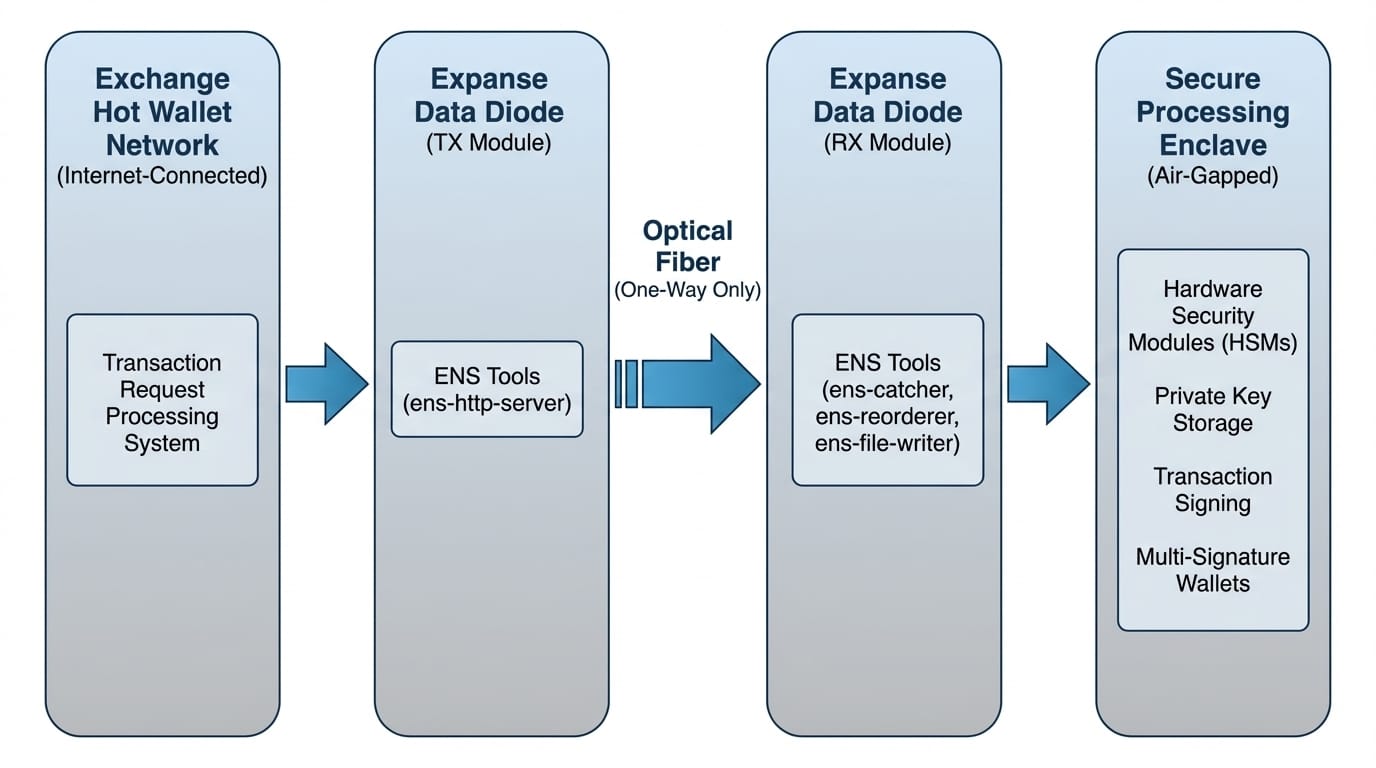
Transaction Request Flow (Inbound)
When a transaction needs to be signed, the exchange hot wallet system sends the transaction request through the data diode:
Hot Wallet Side (Sender):
# HTTP server receives transaction requests
ens-http-server \
  --http-listen-address 0.0.0.0 \
  --http-listen-port 8080 \
  --configured-network-mtu 9000 \
  | ens-rate-limiter --rate-limit-mbps 10 \
  | ens-pitcher \
      --udp-target-address 172.20.1.100 \
      --udp-target-port 64000
Secure Enclave Side (Receiver):
# Receive transaction requests and write to processing directory
ens-catcher \
  --udp-listen-address 0.0.0.0 \
  --udp-listen-port 64000 \
  | ens-buffer --buffer-size 10000 \
  | ens-reorderer --max-packet-queue-len 1000 \
  | ens-file-writer \
      --output-directory /cold-storage/requests
The transaction request file is then processed by the HSM or signing system within the secure enclave, where private keys are stored and never exposed to the internet-connected network.
Signed Transaction Flow (Outbound)
After signing, the transaction is sent back to the exchange network:
Secure Enclave Side (Sender):
# Monitor directory for signed transactions and send them out
find /cold-storage/signed -name "*.txn" -type f | \
  ens-file-reader \
    --configured-network-mtu 9000 \
    --delete-sent-files=true \
  | ens-rate-limiter --rate-limit-mbps 5 \
  | ens-pitcher \
      --udp-target-address 10.60.1.100 \
      --udp-target-port 64001
Hot Wallet Side (Receiver):
# Receive signed transactions
ens-catcher \
  --udp-listen-address 10.60.1.100 \
  --udp-listen-port 64001 \
  | ens-reorderer \
  | ens-file-writer \
      --output-directory /exchange/signed-transactions
```Rendering the UI to canvas (or pre-rendered frames) makes DOM cloning harder but hurts accessibility, SEO, and maintenance. Usually not worth it for a marketing demo.


<div class="callout-tip">

**Bidirectional Communication Pattern**: By using two separate data diodes (one for each direction), you can create secure bidirectional communication patterns while maintaining physically limited, strict ingress / egress points. Transaction requests flow in one direction, signed transactions flow in the opposite direction, but private keys never leave the air-gapped enclave.

</div>

## Key Security Benefits

### Protection Against Remote Attacks

The unidirectional nature of data diodes provides several critical security advantages:

1. **No Reverse Connections**: Attackers cannot establish TCP connections back into the secure enclave because the hardware physically prevents it
2. **No Network Probing**: The secure enclave cannot be pinged, scanned, or probed from the internet-connected network
3. **No Command and Control**: Even if malware were to infect the secure enclave, it cannot "phone home" to attackers
4. **No Protocol Exploits**: Traditional network protocol vulnerabilities (like TCP sequence number prediction) are irrelevant because no bidirectional protocol exists

### Insider Threat Mitigation

Data diodes also help mitigate insider threats:

- **Physical Enforcement**: The one-way property cannot be changed by software configuration or administrative access
- **Cooperative Configuration**: Setting up data flows requires cooperation between administrators on both networks
- **Audit Trail**: All data transfers are logged, providing complete visibility into enclave communications
- **Separation of Duties**: Different administrators control the sending and receiving sides

### Compliance and Regulatory Benefits

For cryptocurrency exchanges seeking regulatory approval, data diodes provide:

- **SOC 2 Type II Compliance**: Demonstrates physical security controls
- **ISO 27001 Alignment**: Meets requirements for network isolation
- **FIPS 140-2 Level 3**: Compatible with hardware security module requirements
- **FinCEN Compliance**: Supports anti-money laundering (AML) and know-your-customer (KYC) requirements
- **Institutional Custody Standards**: Meets requirements for qualified custodians

### High-Frequency Trading Support

For exchanges requiring high-speed transaction processing, ENS provides:

- **Jumbo Frame Support**: MTU up to 9000 bytes for maximum throughput
- **Rate Limiting**: Configurable bandwidth controls to prevent network saturation
- **Buffering**: Large buffers to handle burst traffic patterns
- **Concurrent Streams**: Multiple simultaneous transaction processing streams

Expanse Data Diodes reliably achieve 9.9Gbps transmit speeds with <0.001% packet loss (or lossless with ENS stack use), with a hardware line rate of 10Gbps. For high-throughput requirements, we provide extensive documentation on performance tuning. Remember, you can always add additional diodes to your infrastructure and configure them into an aggregate link while remaining completely compatible with the optional ENS tooling.

### Monitoring and Alerting

While the secure enclave is air-gapped, you can still monitor its status:

**Enclave Status Monitoring (Outbound):**
```bash
# Send status updates and alerts from enclave to monitoring system
ens-stdin | \
  ens-rate-limiter --rate-limit-mbps 1 | \
  ens-pitcher \
    --udp-target-address 10.70.1.100 \
    --udp-target-port 64002
This enables:
- HSM health monitoring
- Transaction processing metrics
- System status alerts
- Compliance audit logs
Conclusion
Cryptocurrency exchanges and custodians face unique security challenges that require solutions beyond traditional network security. The Expanse Data Diode, combined with the Expanse Network Stack software suite, enables secure processing enclaves that provide:
- Hardware-Enforced Security: Physical impossibility of reverse data flow
- Operational Efficiency: Maintains necessary data flows for business operations
- Regulatory Compliance: Meets institutional custody and regulatory requirements
- Scalability: Supports high-frequency trading and large transaction volumes
- Reliability: ENS tools provide error correction and reliable data delivery
By implementing secure processing enclaves with data diodes, cryptocurrency exchanges can protect billions of dollars in digital assets while maintaining the operational efficiency required for competitive trading operations.
Learn More: For detailed technical specifications, deployment guides, and consultation on implementing secure processing enclaves for your cryptocurrency exchange or custody operation, contact the Domain Systems engineering team by emailing [email protected]. We provide hands-on support for organizations implementing hardware-enforced security solutions. If you're an existing customer, also review the official documentation in the Support portal!